Resolving conflict in Galatians 2
Terminal week I preached on Galatians two.1–10 as part of our sermon serial on this letter. Stranded on a train at the weekend because of a landslide, I spent some time wrestling with the main question that has dogged study of Galatians in contempo years: to whom was it written and when? At that place are two principal issues here:
- Was it written to those who were ethnic Galatians, in the northern area of the Roman province (the 'North Galatian hypothesis'? If so, then the letter must be quite late, since Paul is writing to people who know him, and he has not visited this region in his early ministry according to Acts (which doesn't make any clear reference to a visit at all).
- Or was it written to those in the south, including Lystra and Derbe, who were not ethnic Galatians, but did live in the Roman Province named Galatia (the 'Due south Galatian hypothesis'). This would hateful the alphabetic character was (as is usually thought) one of Paul's earliest, and prior to Romans.
 Until the modernistic era, anybody believed the N Galatian hypothesis. Just that all changed when archaeology and epigraphic bear witness made information technology clear that it was quite possible for Paul to address those in the south as 'Galatians', even though that was not true ethnically. (Call up of the exercise of addressing people in the UK as 'Britons' even though ethnically many of us come from dissimilar racial stock, including Celtic, Anglo-Saxon and Scandinavian, before you even consider more recent immigration.)
(Every bit part of my preaching in the evening, I included an 'But Connect'-mode quiz: what is the connection between the proper name Fiona, the city of Vienna, Turkey's majuscule Ankara, and Galaxy milk chocolate? The reply is: the Celts, or Galatikoi every bit they were known in Greek. Originating in the Danube basin, they emigrated south-e into the eye of Turkey, where their capital was Ancyra, modern-day Ankara, and north-west to France, Britain and Ireland. Both Fiona and Vienna mean 'fair' in Celtic, and they were known in Greek by the corresponding term derived from the give-and-take for milk 'gala'. 'Galaxy' in English comes from the Greek 'milky way'.)
Even given the now-bulk consensus on the South Galatian hypothesis, there still remains the question of how Pauls' 2 visits to Jerusalem in Galatians 1 and 2 chronicle to the three visits recorded in Acts 9, 11 and fifteen. Did the visit in Acts 9 actually happen? Is Paul's showtime visit in Gal 1 in fact the same as the two visits in Acts ix and 11 combined? Is Paul'southward visit 'once more' in Gal 2 his 2nd visit in Acts 11, or his third visit at the 'Council of Jerusalem' in Acts 15? Do both Acts and Galatians offer reliable accounts of Paul's travels, or are one or both of them asunder from any historical reality? The arguments are finely counterbalanced, though there are some helpful explorations past Richard Fellowes and my colleague in this diocese, John Allister.
 Whatever the resolution to these questions, Paul's account in Gal 2.one–ten offers some key insights into the resolution of conflict. Justin Welby recently commented on this question in relation to social media. He starts by speaking from his own experience about the damage that disharmonize does:
In a process of reconciliation in which I was involved recently, ane of the questions that people were asked (quite a standard question in these circumstances where the disputes are within the church building) was, "What has this dispute done to your soul?"
You could accommodate the question to different sorts of disputes, not least by changing the word 'soul' to 'spirit' or 'inner self' or something like that. But information technology is a very valid question: the touch of conflict is not only external, but deeply internal. It causes trauma and lasting impairment even where there has been no concrete violence.
I volition remember for a long time a letter of the alphabet I received in the last few years from someone who'd gone through a specially difficult conflict in the church. Information technology was full of what tin can just described as deep trauma and sorrow. It had been deeply damaging.
Paul offers us iv primal principles in our own approach to resolving disharmonize.
 1. Don't blitz in, but trust God's timing
In his account, Paul emphasises the fourth dimension elapsed before he comes to Jerusalem, whichever occasion we empathize this to be. 14 years has gone by (Gal two.1), and Paul'south visit is prompted past a 'vision from God' (Gal two.two). If this second visit corresponds to Acts eleven, and then this 'vision' might be the prophecy of Agabus; if information technology corresponds to Acts fifteen, then information technology looks as though Paul is referring to something revealed to him. (Information technology is worth noting here that Paul was in the habit of sharing whatever vision he has received with those around him—run into the episode in Acts 16.9–10; 'Later on Paul had seen the vision, we got ready at once…')
There are times when we need to take the initiative to be reconciled (Matt 5.23–24, 18.xv), and we are not to conduct resentment from 1 day to the next (Ephesians iv.26). Only at that place are other times when our desire to resolve conflict is really driven by our own anxiety to put others right, or to avoid a state of affairs nosotros find also painful. The danger here is that we think God is not as interested in resolving conflict as nosotros are. And yet it is God who gave himself, in Jesus, to 'reconcile the earth to himself' (two Cor 5.xix).
 2. Play information technology straight
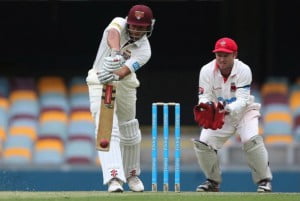
Despite debates about the way Paul uses linguistic communication afterward in this letter, at this bespeak his engagement is past (to use a cricketing metaphor) playing it with a straight bat. In a rather unusual plow of phrase, he talks of 'setting earlier' others his understanding of the gospel (Gal two.2); it is as if he and his dialogue partners are sitting beyond from each other around a tabular array, and Paul has just bundled his ideas on the table in front of them all, open to word and scrutiny. Initially, he does this in private; this is not an exercise in manipulating public opinion. It is not virtually scoring points, but near honest engagement—including an honest account of what others have and have not done (in this case, in relation to Titus).
And playing with a straight bat also means beingness gear up to stand house on the issues that matter (Gal two.5.)
 3. Give due respect
Three times in this passage, Paul describes his discussion partners with respect: they are 'those esteemed as leaders' (Gal two.2); they are 'held in high esteem' (Gal 2.6); and they are 'esteemed as pillars in the church' (Gal 2.9). I call back it is unfortunate that, along with Paul'due south apparent qualification of this ('God shows no favouritism', Gal 2.vi), most English language translations make this sound slightly sarcastic—those 'idea to be' of standing. In fact, commentators are broadly in agreement that Paul is here giving 18-carat credit. And this of course supports the case he is making to the Galatians: those of continuing in the early Christian community support his ministry and agree with his understanding ('they added nothing to my message').
I recall this is supported past Paul'due south slightly odd switch in referring to 'Cephas' in Gal 2.nine when he has simply, twice, referred to him as 'Peter'. The nigh plausible explanation is that he is remembering that Peter was commissioned by Jesus own words. Paul recognises the importance of the person who is potentially his greatest rival, and emphasises (as does Luke in Acts) the parallels betwixt his ministry to the Gentiles and Peter'southward to the Jews (Gal 2.7–8).
Paul does not make his case look expert by trying to make others' look bad. He doesn't make himself look taller past making others look smaller. It has been said that humility is standing at our full peak next to God at his total elevation—and that means standing next to others at their full height too.
When you are in a state of affairs of disharmonize, are you fix to requite due credit to your (actual or potential) opponents? Paul is articulate that this is not virtually fawning to people; God does non pick and cull favourites. But it means being open about the value of other people'southward situation as you are nearly your own.
 4. Keep the primary thing the primary affair
Paul finishes this department by like-minded on a primal business organisation of the gospel—'to recall the poor' (Gal two.ten). Some have argued that this is nigh remembering the Jerusalem church, ofttimes known as 'the poor'. And the Ebionites, a Jewish Christian group that many call up derived from Paul's 'Judaizing' opponents in Jerusalem, derive their proper noun from the Hebrew ebyonim, the 'poor ones'.
In fact (as Bruce Longenecker has persuasively argued) concern for the poor was a consistent feature of Paul'southward ministry building, and was in line with Jesus' own didactics. He who was rich for our sakes became poor (two Cor 8.9); it is the poor (in spirit) who know their demand of God and are open to the grace of God in Jesus' preaching of the kingdom (Matt five.three).
And so Paul offers these primal insights into resolving conflict. And so far, and then business school common sense. Perhaps the virtually fascinating thing about these insights is non so much what we ought to exercise, but what God has done for us. In defending his preaching almost the liberty we have in Christ, Paul is actually exercising this very freedom.
All too often, it is the things which imprison united states which prevent us from doing what Paul does hither. Trapped in our anxiety, we rush in to fix things right. Trapped in our insecurity, nosotros try to manipulate the truth. Trapped in our lack of self-esteem, we are tempted to belittle others. And trapped in our pre-occupation with our ain interests, we accept our eye off the ball.
For Paul, the practiced news about God's grace in Jesus liberates us from all these fears, anxieties and insecurities. We tin can allow go of our own express perspectives equally we accept been called to a bigger vision of what it ways to be whole in Christ.
It is for freedom that Christ has set us free (Gal 5.1)—that nosotros might be free to proclaim to others the freedom we ourselves have experienced.
(You lot can heed to the sermons I preached on this at the St Nic's website hither and here.)
Much of my work is done on a freelance basis. If you have valued this post, would you considerdonating £1.twenty a month to support the production of this blog?
If you enjoyed this, exercise share it on social media (Facebook or Twitter) using the buttons on the left. Follow me on Twitter @psephizo. Similar my page on Facebook.
Much of my work is done on a freelance basis. If you lot accept valued this mail, you can make a unmarried or repeat donation through PayPal:
Comments policy: Good comments that engage with the content of the post, and share in respectful fence, can add existent value. Seek first to sympathize, then to be understood. Make the most charitable construal of the views of others and seek to learn from their perspectives. Don't view debate as a conflict to win; address the argument rather than tackling the person.
Source: https://www.psephizo.com/life-ministry/resolving-conflict-in-galatians-2/

Post a Comment for "Resolving conflict in Galatians 2"